
Malpas and the Roman Link
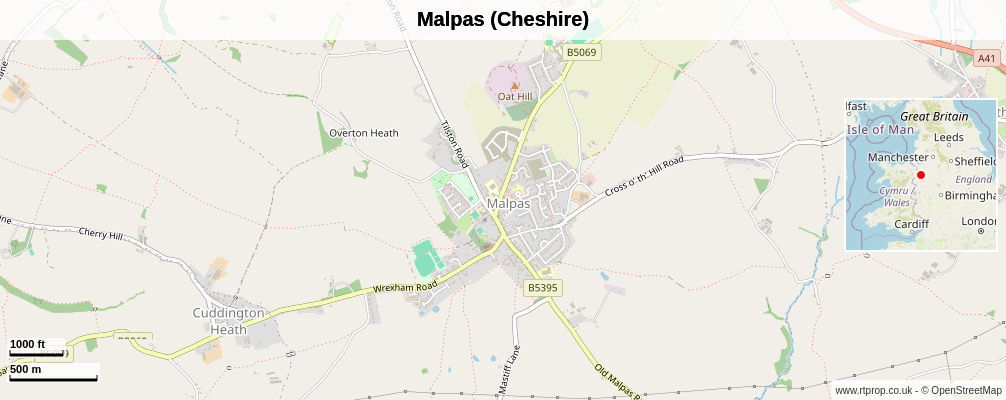
Malpas is a historic village in south Cheshire, close to the Welsh border with an interesting past...
Its position places it within a landscape that has long been shaped by the movement of people between Cheshire and north Wales, and the village has a history extending well beyond its present-day appearance.
The name Malpas is generally derived from the Old French mal pas, meaning bad passage or difficult way. The name may have referred to the difficulty of travelling through the area, perhaps reflecting the condition of the route and its potentially wet or poorly drained ground, although the precise reason for the name is uncertain. It is an interesting reminder of the influence of the Normans and the French language on the English landscape after the Norman Conquest. Place names of this type were sometimes descriptive, reflecting the character of a route or the difficulties encountered by travellers.
The area was also part of the Roman world. A particularly interesting reminder of this comes from a Roman military diploma discovered at Malpas. Dating from AD 103, the diploma records Reburrus, a cavalry officer serving in the Roman army. He belonged to the First Pannonian Cavalry Regiment and is identified as being from Spain. His presence provides a tangible example of how far people could travel within the Roman Empire: a man from the Iberian Peninsula serving in Roman Britain almost 2,000 years ago.
Malpas later developed as an important local centre, with its medieval church and position on routes through the southern Cheshire countryside giving it a significance beyond that of a purely rural settlement. St Oswald's Church, with its distinctive tower, remains one of the most prominent features of the village and reflects the area's long ecclesiastical history.
Today Malpas retains much of the character of a historic Cheshire village, surrounded by farmland and small settlements. Its story, however, reaches back through the medieval period and into Roman Britain, making it a good example of how apparently quiet modern villages can preserve traces of much older networks of travel, administration and settlement.
Sep 2026